Company
About Solmax Polymer Engineering
Since 1978, Solmax has advanced geosynthetic containment science—linking resin formulation, extrusion discipline, and field support so infrastructure owners can trust liners under chemistry, heat, and load.
Our mission is to make containment performance measurable before earthworks start—so UV stability, puncture resistance, and dimensional stability are design inputs, not after-the-fact hope.
That stance shapes how we staff laboratories, publish technical data sheets, and coach welding crews. When architects prioritize visual finishes and engineers prioritize structural and hydraulic performance, Solmax sits with the engineers—translating polymer behavior into language owners can put into contracts without watering down safety margins.
We also publish the limits: textured liners raise interface shear but demand tighter welding discipline; recycled resin pilots remain construction-specific; and NSF/ANSI 61 pathways apply to listed potable-water grades—not every mining geomembrane in the catalog.
Founded in 1978 and operating across 90+ countries with roughly 400 million m² of annual geomembrane capacity, Solmax staffs ISO 9001:2015 and ISO 14001:2015 plants alongside GRI-aligned product families. Mechanical coupons follow ASTM D6693 tensile and ASTM D4833 puncture suites; UV programs reference ASTM D7238 / QUV exposure windows that specification writers can cite by method number rather than vague “weathering” language.
On the clay-versus-engineered debate, our engineers quantify leakage criteria, borrow-source proximity, and construction duration side by side. Prefabricated panel kits compress weather risk; field welding preserves geometry flexibility. Neither path erases soft-subgrade risk—geomembranes do not replace structural slabs or correct poor compaction.
Research facilities that stress liners before the field does
Polymer labs and pilot extrusion lines validate moisture vapor transmission, tensile retention after UV weathering, and interface shear with drainage composites before lots ship to basins and landfill cells.
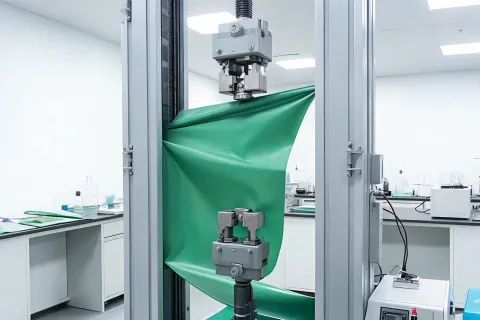
Mechanical characterization
Yield, elongation, and puncture suites (ASTM D6693 / D4833) that feed compressive strength and impact resistance guidance for ore stacks and equipment traffic.
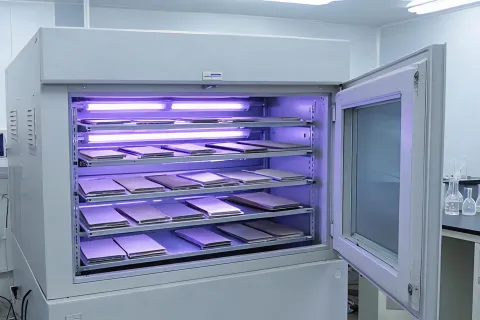
UV & thermal aging
Accelerated QUV / D7238 exposure that informs service life expectancy on freeboard slopes remaining uncovered for multiple seasons.
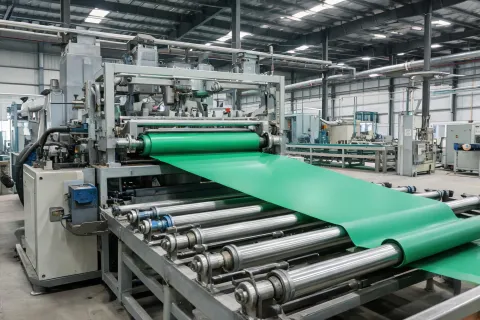
Pilot extrusion
Small-lot trials that raise recycled content percentage while holding moisture vapor transmission and dimensional stability targets for the listed construction.
Technical publications & design downloads
White papers and design notes help specification writers compare engineered geomembranes against clay barriers when schedule, leakage, and embodied carbon are all on the table.
-
Request PDF
HDPE Geomembrane Thickness Selection Guide
Maps chemical exposure and hydraulic head to recommended thickness bands with UV stability footnotes.
-
Request PDF
Interface Shear Testing Notes for Textured Liners
Summarizes frictional performance with geocomposite drainage under high normal stress.
-
Request PDF
Seam QC Field Checklist (2024 revision)
Welding window checks, destructive sampling cadence, and repair documentation templates.
Partner with a containment manufacturer that still runs labs
Ask for plant tours, ASTM/GRI method references, or anonymized project references in mining and municipal waste. Bring chemistry lists and hydraulic head assumptions; Solmax returns thickness bands, warranty period language, and the test methods behind them—not scripted generic replies.